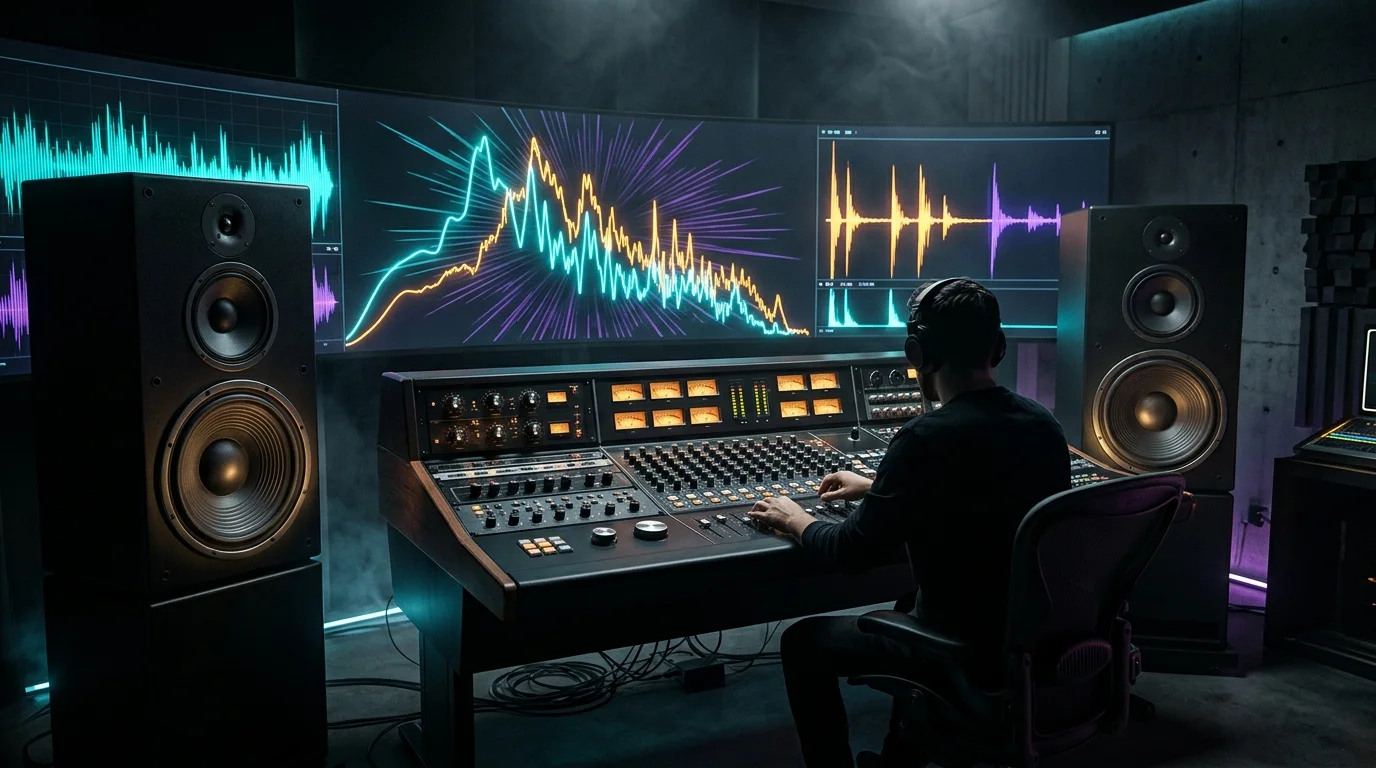
The Anatomy of the Low-End: Why Mixing Kick & 808 is Audio Engineering Hell
In modern music production—from Trap and Drill to Hip-Hop, Pop, R&B, and Electronic music—the emotional weight, bounce, and physical impact of a record rest entirely on two elements: the transient punch of the kick drum and the resonant, sustained energy of the 808 sub-bass. Yet over 90% of emerging producers face the exact same frustrating roadblock: the moment kick and bass play together, the mix devolves into a sluggish, muddy soup where the kick disappears completely, or the 808 causes catastrophic speaker distortion in cars and headphones.
The underlying culprit lies in acoustic physics: the sub-100Hz frequency spectrum contains the longest wavelengths and the densest acoustic energy in human hearing. A 40Hz sound wave in air stretches across more than 8.5 meters (28 feet)! These massive, slow-moving waveforms devour digital headroom in your DAW and rapidly push master limiters into distortion. When two heavyweight low-end elements collide in the exact same frequency real estate (typically between 40Hz and 80Hz), acoustic masking occurs—human ears can no longer distinguish where the kick transient ends and the 808 tail begins.
Even worse is phase cancellation: if the acoustic crest of a kick wave meets the trough of an 808 wave at the moment of impact, the two soundwaves cancel each other out physically. The result? Your sub-bass sounds hollow, paper-thin, and powerless despite cranking up volume faders. Pushing volume sliders higher will never fix a low-end conflict; the true solution lies in territory carving, phase alignment, and harmonic precision.
Pushing faders up on both kick and 808 simply slams your master bus limiter into unnatural gain reduction, destroying the dynamic transient punch of your drums. In the sub-bass realm, clarity is always won by surgical cuts and subtractive carving, never by competitive volume boosting!
Tuning Your Kick & 808: Harmonic Foundations with Music Theory
A pervasive myth among modern beatmakers is that drum kits are purely unpitched percussive elements detached from music theory. In truth, an 808 sub-bass is a full melodic instrument with defined fundamental pitches, and an acoustic or synthesized kick drum possesses a very specific resonant frequency peak. If your kick drum naturally resonates on an F# (approx. 46Hz) while your 808 hits a G root note (approx. 49Hz), a vicious 3Hz microtonal dissonance occurs, creating muddy frequency beating that sounds instinctively clunky and amateur.
Tracking 808 Root Notes to Chord Progressions: Your 808 bassline must accurately anchor the fundamental root notes of the underlying chord voicings. For instance, if you build a dark progression in D Minor in MojoMelody moving from Dm -> Bb -> Gm -> A, your 808 line must lock into D (36.7Hz or 73.4Hz), Bb (58.2Hz), G (49Hz), and A (55Hz) with surgical pitch accuracy.
Intelligent Kick Drum Tuning: To avoid direct harmonic collisions, producers tune the kick drum in one of two ways: either precisely to the tonic root of the track's key, or tuned to the Perfect 5th interval above the root note. Tuning the kick to the 5th interval provides rich harmonic cohesion with the chord progression while naturally shifting the kick's resonant peak away from the 808's fundamental note.
How to Detect Kick Pitch in Your DAW: Drop a high-resolution spectrum analyzer (such as Voxengo SPAN) or your DAW's pitch-detection tool (like FL Studio's Edison or Ableton's Tuner) on the kick channel. Identify the highest frequency spike within the first 50 milliseconds of the transient, and adjust the pitch knob in your sampler to snap it directly to the key of your song.
Detect Kick Resonant Pitch
Transient Spectrum AnalysisUtilize high-precision spectrum analyzers to isolate the fundamental frequency spike within the kick drum attack.
Track Chord Root Notes
MojoMelody Harmony MappingAlign 808 MIDI basslines directly with the root notes generated by MojoMelody's smart voice-leading matrix.
Tune to the Perfect 5th
Complementary Harmonic PunchTune the kick 7 semitones higher than the track key to provide visceral punch without low-end clash.
Phase Alignment at Impact
Polarity Inversion CheckZoom into the sample timeline and flip phase 180 degrees to guarantee maximum forward momentum.
The Frequency Duel: Vertical Separation & Territory Allocation
The core philosophy of pro audio mixing dictates: "You cannot have both a massive sub-heavy kick drum and a gargantuan, sub-heavy 808 bass in the exact same track. One must rule the sub-60Hz basement, and the other must govern the 60Hz to 120Hz chest-punch punch territory." This is known as vertical frequency allocation.
Strategy A: Deep Sub 808 + Punchy Mid Kick (Modern Trap & Pop Standard): The 808 dominates the deepest 30Hz to 60Hz zone. The kick drum is high-passed gently around 40Hz with an intentional resonant boost centered between 70Hz and 100Hz. This ensures the kick provides physical chest impact while the 808 rumbles beneath it.
Strategy B: Sub-Heavy Kick + Distorted Mid-Range 808 (UK Drill & Rock-Infused Hip-Hop): In this framework, the kick delivers the thunderous sub-45Hz impact. The 808 is filtered out below 55Hz, but heavily saturated with tube or tape distortion so its melodic presence cuts through between 100Hz and 300Hz.
Surgical Complementary EQ Carving: Inspect your kick channel with a precision parametric EQ (like FabFilter Pro-Q 3). If your kick's punch peaks at 65Hz, apply a narrow notch cut of 3dB to 5dB at exactly 65Hz on the 808 track. Conversely, if your 808's fundamental note resonates at 42Hz, dip the kick by 3dB at 42Hz. These interlocking EQ cuts fit together like mechanical puzzle pieces, clearing breathing room for both instruments.
Frequencies below 25Hz to 30Hz are virtually inaudible to human ears, yet they drain more than 40% of amplifier power and trick mastering limiters into premature pumping. Applying a clean 18dB/octave high-pass filter at 28Hz to both kick and 808 unlocks massive clean headroom across your entire mix!
| Frequency Zone | Kick Drum Function | 808 Sub-Bass Function | Mixing Action Required |
|---|---|---|---|
| 20Hz - 40Hz (Sub Rumble) | Infrasonic energy filtered out with steep High-Pass | Sub-bass rumble zone for deep modern trap 808s | High-pass filter below 28Hz to preserve digital headroom |
| 40Hz - 65Hz (Deep Sub) | Secondary body or fundamental (based on strategy) | The reigning territory of fundamental 808 root notes | Carve 3dB-5dB notch in one channel to yield space |
| 65Hz - 120Hz (Chest Punch) | Primary knock and chest-thumping transient impact | First harmonic overtones and upper body | Dynamic sidechaining applied during kick transient |
| 120Hz - 300Hz (Boxy / Warmth) | Boxiness zone typically scooped out by 2dB-4dB | Melodic warmth and audibility on medium speakers | Gentle scoop on kick; mild harmonic boost on 808 |
| 1kHz - 5kHz (Beater Click) | Plastic beater click for earbud and mobile translation | Saturated overtones from distortion plugins | Boost kick click slightly for razor-sharp definition |
Intelligent Dynamic Sidechaining: Pumping-Free Gain Reduction
Many beginners mistakenly slap a broad-band compressor sidechain on the entire 808 track with a sluggish release time. The result is disastrous: every time the kick fires, the entire bassline drops in volume and slowly creeps back up with an obnoxious, breathless pumping artifact that completely destroys the rhythmic bounce.
Method 1: Frequency-Specific Dynamic Sidechaining: Instead of pulling down the entire 808 volume, utilize a dynamic EQ or multiband compressor (such as FabFilter Pro-MB or Waves F6). Route the kick as the external sidechain trigger, and restrict the gain reduction exclusively to the clashing 50Hz to 90Hz band. When the kick hits, only that specific clashing pocket dips by 3dB to 5dB for a fraction of a second, while the deep sub and upper harmonics of the 808 continue singing untouched!
Method 2: Time-Domain Volume Ducking Envelopes: Employ envelope shaping tools like Cableguys VolumeShaper, Kickstart, or fast DAW automation. Draw an ultra-fast downward curve that dips 808 volume exclusively for the first 35 to 60 milliseconds of the kick strike (the exact duration of the kick's attack transient) before instantly snapping back to 100%. This completely bypasses frequency collision without any audible pumping.
Adjusting Sampler Attack & Decay: If your kick sample has an exceptionally sharp attack, simply dial in a 5ms to 10ms attack delay on your 808 sampler. Those few milliseconds allow the tip of the kick to pierce through the mix cleanly before the full weight of the 808 wave blooms into the room.
Before loading any plugins, flip the phase switch (Invert Polarity) on either your kick or 808 channel while listening in mono. In over 50% of real-world mixing sessions, inverting phase aligns the waveforms so they reinforce rather than cancel, doubling perceived punch in one second!
Harmonic Saturation & Mono Management: Making 808s Audible on Phones & Cars
The Small Speaker Paradox: The miniature speaker drivers in modern smartphones, tablets, and laptops physically cannot move enough air to reproduce soundwaves below 150Hz. How do major Billboard charting trap hits and pop songs still boast punchy, instantly recognizable 808 lines when streamed through Instagram or TikTok on an iPhone?
The Psychoacoustic Secret: The Phantom Fundamental (The Missing Fundamental effect). The human auditory cortex is an astonishing pattern-recognition engine: if an audio signal is stripped of its 50Hz fundamental pitch, but presents clean, reinforced 2nd harmonics (100Hz), 3rd harmonics (150Hz), and 4th harmonics (200Hz), the brain automatically reconstructs the perceived 50Hz root note in your head!
Applying Targeted Harmonic Saturation: Using tape or tube saturation plugins (such as Soundtoys Decapitator, FabFilter Saturn, or DAW native waveshapers), add controlled harmonic distortion to the 150Hz to 800Hz range of your 808. This generates warm mid-range overtones that make the bass line articulate crisply on cheap earbuds and mobile speakers without needing to crank up raw sub-bass volume.
The Iron Law of Mono Bass Management: Every piece of audio information below 100Hz MUST BE 100% MONO. Any stereo width or phase discrepancy in the sub-bass realm will cause catastrophic phase cancellation when collapsed to mono in club sound systems, arena PAs, or mobile speakers. Use a utility stereo imager (like iZotope Ozone Imager or DAW native utility) to sum everything below 120Hz dead-center to mono.
Sample Curating & Key Alignment
Matching Kick & 808 with ChordsSelecting complementary kick and 808 samples, and rigorously tuning the 808 root notes to the progression created in MojoMelody.
Infrasonic Filtering & Inverse EQ
Cleaning Headroom & TerritorySteep high-pass filtering below 28Hz to reclaim headroom, followed by complementary 3dB notches between kick punch and bass.
Multiband Sidechain & Phase Alignment
Transient Protection & Polarity CheckAuditioning 180-degree polarity inversion and setting up dynamic EQ sidechaining on the clashing 60Hz-90Hz band.
Harmonic Saturation & Mono Sub Summing
Phone, Earbud & Club CompatibilitySumming sub-100Hz frequencies to pure mono and introducing mid-frequency saturation to ensure clear playback on all mobile devices.
Frequently Asked Questions
Q:Why does my 808 sound great in headphones but muddy and boomy in the car?
Car interiors are small acoustic enclosures prone to severe standing waves and cabin resonance. Uncontrolled sub-frequencies below 35Hz overwhelm car subwoofers. High-pass filter both kick and bass below 28Hz-30Hz and tame the 50Hz-60Hz region with a dynamic EQ.
Q:Should the sub-bass region below 100Hz always be in mono?
Yes, without exception. Low-frequency soundwaves are non-directional. Having stereo width below 100Hz causes severe phase cancellation on mono club sound systems, PA speakers, and smartphones, completely hollowing out your bass impact.
Q:What is the main advantage of dynamic EQ sidechaining over traditional compression?
A traditional sidechain compressor ducks the entire 808 signal, creating an amateur pumping sound and chopping off musical sustain. Dynamic EQ sidechaining ducks ONLY the specific colliding frequency pocket (e.g., 65Hz-85Hz) for a fraction of a second, leaving the sub rumble and upper harmonics intact.
Q:How does MojoMelody simplify 808 bassline writing for producers?
MojoMelody analyzes your chord progressions and highlights the exact musical root notes and fifth intervals. By exporting the progression as a separate bass MIDI file directly into your 808 sampler, you guarantee perfect harmonic alignment with zero pitch clashes.