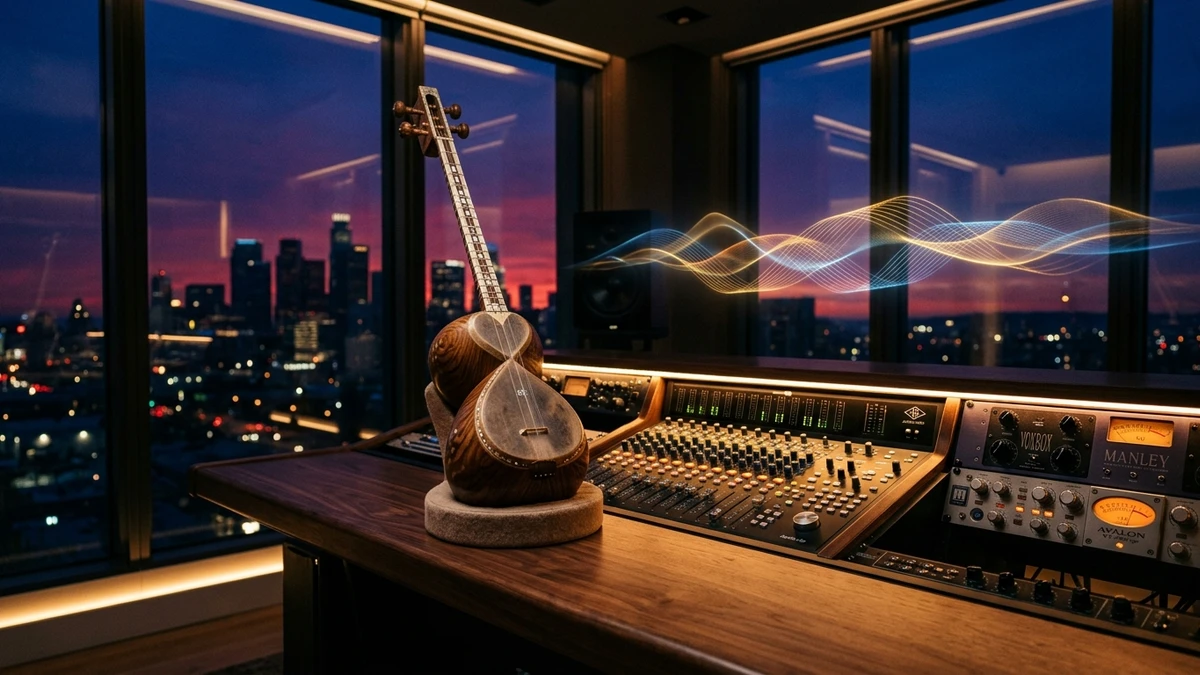
Emotional Gravity of Homayoun and Esfahan in Contemporary Production
Across the twelve Persian Dastgahs and modal systems, none command greater emotional resonance in modern songwriting than Dastgah Homayoun and its lyrical derivative, Bayat-e Esfahan. Characterized by royal dignity, dramatic tension, and poignant nostalgia, these modes underpin legendary film scores, classical masterpieces, and contemporary chart-topping pop and crossover hip-hop productions.
While Western producers frequently draw comparisons between Persian modes and standard scales, attempting to voice Homayoun or Esfahan strictly using 12-TET equal temperament flattens the authentic acoustic spirit that distinguishes Middle Eastern modal art.
The central hurdle confronting producers in FL Studio, Ableton Live, and Cubase is navigating neutral quarter-tone intervals without causing third-party VST synths to detune chaotically during polyphonic playback.
In classical Radif theory, Bayat-e Esfahan operates as a primary Avaz branching from Dastgah Homayoun. While its initial tetrachord evokes a minor coloration, cadential resolutions naturally dissolve into the majestic tonic axis of Homayoun.
The Vital Distinction: Bayat-e Esfahan vs. Western Harmonic Minor
One of the most persistent misconceptions among modern beatmakers is equating Bayat-e Esfahan with the Western Harmonic Minor scale. While modern pop arrangements occasionally utilize a tempered 12-TET approximation, authentic Esfahan features a microtonal neutral 4th degree.
In standard C Harmonic Minor, the degrees are: C - D - Eb - F - G - Ab - B - C.
In traditional C Bayat-e Esfahan, the fourth degree is tuned as F Koron (F quarter-flat, -50 cents): C - D - Eb - F koron - G - Ab - B - C.
That 50-cent neutral shift produces a deeply moving melancholic resonance that Western equal temperament cannot replicate. Voicing Esfahan strictly with natural F shifts the sonic identity toward Balkan, Klezmer, or Spanish Phrygian rather than genuine Persian classical heritage.
| Scale / Mode | 2nd Degree | 3rd Degree | 4th Degree | 7th Degree | Sonic Character |
|---|---|---|---|---|---|
| Traditional C Esfahan | D (natural) | Eb (flat) | F koron (-50 cents) | B (natural/sharp) | Authentic, deeply nostalgic & evocative |
| Western C Harmonic Minor | D (natural) | Eb (flat) | F (natural 12-TET) | B (natural leading) | Dramatic, classical & neoclassical |
| Dastgah Homayoun (G root) | A koron (-50 cents) | B (natural / 400c) | C (natural 12-TET) | F (subtonic 12-TET) | Majestic, royal & suspended tension |
Polyphonic Harmony & The Augmented Neutral Interval in Homayoun
Dastgah Homayoun on root G possesses one of the most exotic scalar architectures in world music:
G (Tonic) - A koron (-50 cents) - B (Major 3rd) - C (4th) - D (5th) - Eb (Minor 6th) - F (7th) - G
The distance between A-koron (150 cents above tonic) and B natural (400 cents) creates an expanded neutral interval of 250 cents. This unexpected leap establishes the hallmark royal tension of Homayoun.
Four production-proven chord progression formulas in this mode include:
1. The Royal Homayoun Cycle: G(neutral) -> Cm -> Abmaj7 -> G. The submediant Ab major triad descending into the G tonic produces cinematic orchestral grandeur.
2. The Romantic Esfahan Turnaround: Cm -> Fm(koron) -> G7 -> Cm. Smooth voice-led cadence creating tear-jerking harmonic resolution.
3. Contemporary Fusion Progression: Ab -> Bb -> G7/B -> Cm. Modern inverted bass movement ideal for commercial radio ballads.
4. The Dramatic Suspense Builder: Ebmaj7 -> Ddim -> Gsus(koron). Exceptional tension ramp preceding beat drops and vocal entrances.
Because A-koron (-50 cents) and B natural (standard tuning) sound in close proximity within Homayoun harmony, drawing global pitch bends in DAW piano rolls detunes both notes simultaneously. Discrete multi-channel routing is essential for clean polyphony.
Effortless Harmony with MojoMelody: The Dedicated Persian Chord Machine
MojoMelody was engineered specifically to dismantle these technical barriers, functioning as a dedicated Persian chord machine and intelligent progression generator for FL Studio, Ableton Live, and Cubase.
Simply select Dastgah Homayoun or Bayat-e Esfahan on your chosen key, and MojoMelody instantly exposes 53 harmonized chord variations calibrated to authentic microtonal offsets. All inversions feature automated voice leading to ensure smooth, step-wise transitions across pads and pianos.
With single-click MIDI drag-and-drop, you can place multi-channel polyphonic chords directly into your DAW playlist or piano roll with zero configuration headaches, fully compatible with Serum, Nexus, Kontakt, and Omnisphere.
Frequently Asked Questions
Q:Can Bayat-e Esfahan be produced without quarter-tones in modern DAWs?
Yes. In modern commercial Persian pop, a tempered 12-TET variation based on Western Harmonic Minor is widely used. However, utilizing the authentic fourth-degree Koron tuning delivers a significantly more profound nostalgic emotional signature, and MojoMelody supports both configurations.
Q:Why is the interval between the second degree (Koron) and third degree in Homayoun so powerful?
The 250-cent neutral augmented interval between A-koron (150 cents) and B-natural (400 cents) does not exist in standard 12-TET tuning. This unique acoustic gap blends minor melancholy with major resolution, establishing Homayoun’s signature royal dignity.
Q:What is the structural difference between Dastgah Homayoun and Bayat-e Esfahan?
Bayat-e Esfahan is an Avaz branching from Homayoun. Esfahan centers primarily around its minor-like opening tetrachord before cadencing toward Homayoun, whereas Homayoun establishes its tonic gravity immediately on its neutral second and major third.
Q:How do I combine Homayoun chord progressions with Trap or Drill sub-bass?
Employ open voicings across octaves 3 and 4 for your pad and keyboard layers, leaving the sub-120 Hz spectrum clean for an 808 glide. Progressions such as Abmaj7 into G tonic deliver thunderous cinematic impact over modern drill percussion.
Q:Does MojoMelody function as a dedicated chord machine for Dastgah Homayoun and Esfahan?
Yes! MojoMelody is engineered as a dedicated Persian chord machine and progression generator. It automatically computes accurate microtonal offsets, modal scale degrees, and polyphonic voice leading for all Persian Dastgahs with instant drag-and-drop MIDI export into any DAW.