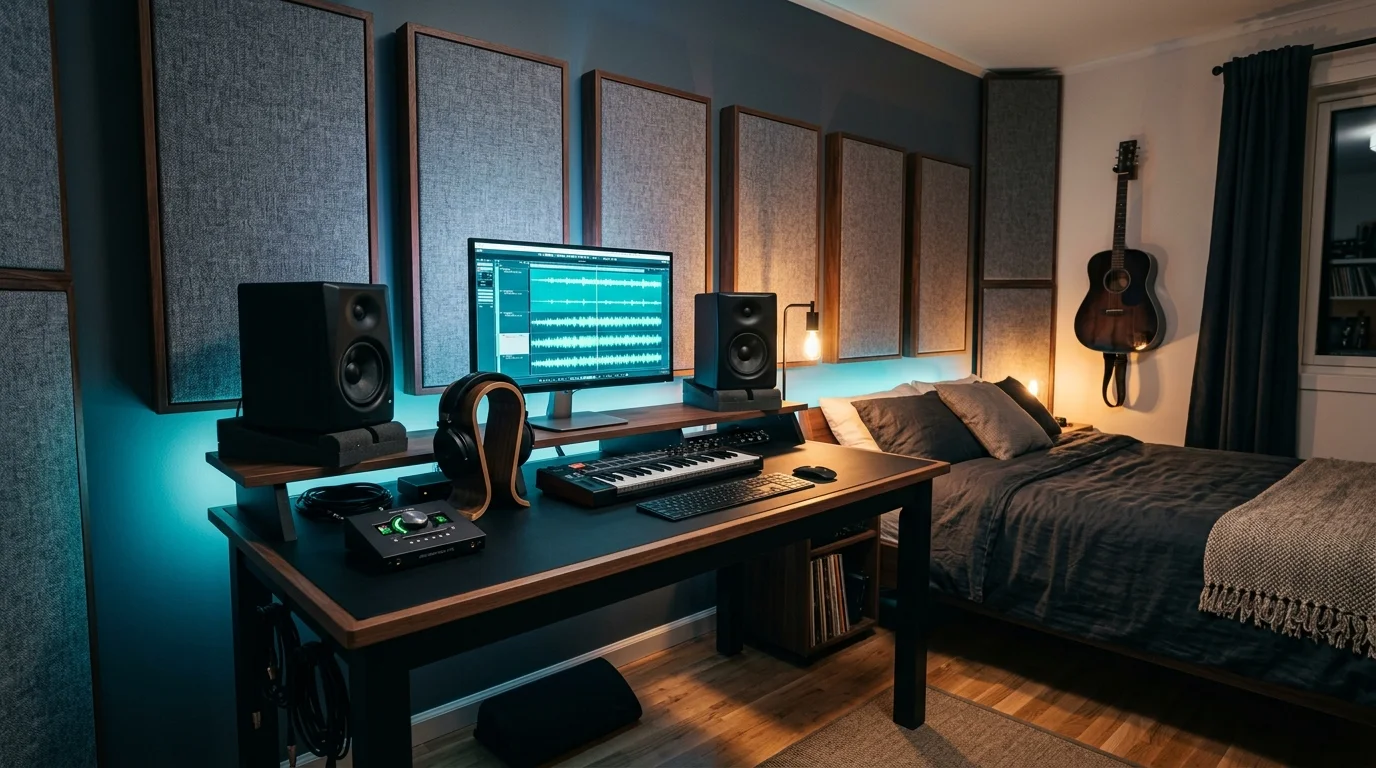
The Beginner's Trap: Gear Acquisition Syndrome (GAS) & The Hardware Myth
One of the most expensive and frustrating pitfalls for aspiring music producers is Gear Acquisition Syndrome (GAS)—the mistaken belief that radio-ready music requires thousands of dollars in vintage tube preamps, boutique condenser microphones, and giant 8-inch studio monitors.
Acoustic physics paints a very different reality: placing a pair of $2,000 studio monitors in an untreated bedroom with parallel drywall, glass windows, and hard flooring will not make your mixes sound better. In fact, it will sound significantly worse. Severe acoustic phenomena—such as room modes, standing waves, and flutter echo—create false acoustic illusions. You might boost the bass because of a cancellation dip at your listening spot, only to find your track obliterating car speakers with muddy distortion.
The 80/20 rule of home recording dictates that 80% of perceived production quality originates from three fundamentals: an accurate listening reference (flat headphones or properly treated acoustics), musical competency (stellar chord progressions and voice leading), and a disciplined mixing workflow. Investing wisely in the core essentials yields dramatically better results than splurging on hyped hardware.
An ultra-sensitive high-end condenser microphone in an untreated bedroom will capture computer fan hum, street traffic, and ugly boxy room flutter with pristine clarity. Always balance equipment sensitivity with your listening environment.
The 5 Non-Negotiable Pillars of a Budget Home Studio
If you want to stretch every single dollar for maximum sonic impact, your home setup needs exactly 5 core pillars. Anything beyond these in the first year is secondary luxury.
1. A Reliable Computer with NVMe Storage: Modern music production does not require high-end gaming rigs. A modern multi-core processor (Core i5/i7, AMD Ryzen 5+, or Apple M-series Silicon), at least 16GB of RAM, and ultra-fast NVMe SSD storage for low-latency sample streaming form a rock-solid foundation.
2. Low-Noise Audio Interface: Your interface handles pristine Analog-to-Digital and Digital-to-Analog conversion alongside dedicated ASIO low-latency drivers. Workhorses like the Focusrite Scarlett 2i2, MOTU M2, or Behringer UMC204HD provide exceptional dynamic range and transparent preamps.
3. Honest & Flat Monitoring: You need an uncolored, ruthlessly honest auditory reference rather than commercial bass-boosted consumer speakers.
4. Core DAW & Harmony Engine: Whether you produce in FL Studio, Ableton Live, or Logic Pro, creative workflow speed is king. Intelligent chord tools like MojoMelody eliminate writer's block and remove the need for overpriced third-party MIDI packs.
5. Expressive MIDI Controller: A compact 25-key or 49-key velocity-sensitive MIDI controller allows tactile connection to piano rolls, capturing expressive dynamics that mouse-clicking can never replicate.
Studio Computer
Processing & Stability16GB+ RAM and fast NVMe SSD storage to guarantee drop-out-free DAW performance.
Audio Interface
Clean Preamp & Low Latency2-in/2-out USB interface with rock-solid ASIO drivers for seamless recording.
Flat Studio Headphones
Honest Frequency ResponseOpen-back or accurate closed-back headphones that bypass bedroom acoustic flaws.
DAW & Creative Copilot
Harmony & Composition CoreYour favorite host DAW paired with MojoMelody for lightning-fast chord voicings.
MIDI Controller
Tactile Velocity & Expression25 or 49 velocity-sensitive keys to articulate chords and lead lines naturally.
The Great Showdown: Studio Headphones vs Monitors in Untreated Rooms
Should you buy a pair of 5-inch studio monitors or invest in reference studio headphones? In an untreated domestic room, reference headphones win by a landslide.
The Physics Behind It: Studio monitors emit acoustic soundwaves that propagate through the room. Bass frequencies below 200Hz have wavelengths several meters long. When these waves reflect off parallel walls, they collide, creating standing waves and comb filtering. In typical bedrooms, you will experience massive cancellation dips (-12dB to -18dB) and boomy frequency peaks (+10dB). You simply cannot EQ or mix what your room is hiding from you.
Headphones completely take the room out of the acoustic equation. However, choosing the right headphone architecture is vital:
Open-Back Headphones: The outer earcups feature a permeable mesh that lets air and sound pass freely. This prevents internal acoustic resonances, expands the stereo soundstage, and dramatically reduces listening fatigue during long mixing sessions. Benchmark examples include the Beyerdynamic DT 990 Pro, Sennheiser HD 560S, and Philips Fidelio X2HR.
Closed-Back Headphones: The earcups are sealed, providing passive sound isolation. These are mandatory for vocal and acoustic instrument tracking to prevent backing track bleed into the microphone, and they deliver punchier sub-bass response (e.g., Audio-Technica ATH-M50x, Sony MDR-7506, Beyerdynamic DT 770 Pro).
Buy a high-quality pair of open-back headphones first. Master your balance, tonal shaping, and chord voicing. Once you build or buy acoustic treatment, add 5-inch studio monitors as a secondary check.
| Criteria | Studio Monitors in Untreated Room | Open-Back Studio Headphones |
|---|---|---|
| Room Acoustic Dependency | Extremely high (demands costly bass traps & panels) | Zero (bypasses room modes entirely) |
| Low-End Bass Accuracy | Severely skewed by standing waves & room modes | Exceptionally linear, transparent, and detailed |
| Stereo Imaging & Depth | Blurred by early wall reflections & flutter echo | Expansive, natural, and micro-detailed |
| Total Setup Investment | Very high (Monitors + Isolation pads + Room panels) | Highly cost-effective with immediate 100% utility |
| Late-Night & Apartment Friendly | Poor (inevitably disturbs neighbors and housemates) | Completely silent, private, and 24/7 accessible |
DIY Acoustic Treatment: Escaping the Egg-Crate Foam Illusion
Few myths in home recording are as pervasive and damaging as thin polyurethane "egg-crate" foam panels. Sticking cheap foam tiles to your drywall will not fix your room.
Soundproofing vs. Acoustic Treatment: Soundproofing prevents sound from entering or escaping a room (requiring mass, decoupling, and heavy construction). Acoustic treatment controls how sound behaves inside the room by taming reflections and flattening reverberation times.
The Foam Fallacy: Thin foam tiles only absorb high frequencies (>2.5kHz–3kHz). They leave boomy bass and muddy lower-mid frequencies completely untouched, turning your bedroom into a dull, boxy, muffled cave with uncontrolled low-end rumble.
How to Build Professional DIY Rockwool Panels for Pennies:
1. Timber Framing: Construct 120cm x 60cm rectangular wooden frames with a depth of 5cm to 10cm.
2. High-Density Mineral Wool: Fill the frame with rigid rockwool (density 50 to 80 kg/m3). Rockwool is the gold-standard porous broadband absorber utilized in world-class commercial studios.
3. Breathable Fabric Wrap: Wrap the frame tightly with breathable fabric (cotton, linen, or duck canvas). The blow test: if you can easily blow air through the fabric, it is acoustically transparent.
4. The Mirror Technique for Early Reflections: Sit at your mixing position and have a friend glide a handheld mirror along the left and right walls. Wherever you see the reflection of your monitor tweeters in the mirror is an early reflection point where a panel must be mounted.
5. Corner Bass Traps: Room corners act like acoustic megaphones for low frequencies. Straddling 10cm-thick rockwool panels across room corners absorbs the most problematic low-end energy.
If you have zero budget: an open closet packed with hanging coats and blankets, a bookshelf filled with irregular-depth books (acting as a natural acoustic diffuser), and heavy velvet curtains perform 10x better than cheap foam tiles.
Budget Priority Checklist: Tiered Setups from Scratch
To help you allocate your budget logically without wasting money on shiny toys, we have structured the ideal home studio trajectory into three clear milestones:
Tier 1: The Essential Starter ($150 - $250): Existing laptop or PC + affordable studio headphones (closed or open back) + compact 2-channel audio interface + your favorite DAW + MojoMelody. Zero acoustic construction needed; 100% focused on songwriting, chord progressions, and arrangement.
Tier 2: The Producer's Sweet Spot ($500 - $800): Add an expressive 49-key MIDI keyboard controller + build 4 to 6 DIY rockwool acoustic panels for primary reflection points + upgrade to reference open-back headphones + clean budget condenser microphone (e.g., Rode NT1-A or Audio-Technica AT2020).
Tier 3: The Semi-Pro Desktop Studio ($1,500+): 5-inch nearfield studio monitors (e.g., Kali LP-6 or Yamaha HS5) placed on desktop acoustic isolation pads + corner bass traps + software room calibration.
Critical Pre-Record Studio Placement: Position your desk along the longest wall dimension, place your monitors and listening head in an equilateral triangle, align tweeters precisely at ear level, and pull speakers at least 30cm away from the front wall.
Digital Foundation & Composition
DAW, Interface & Flat HeadphonesEstablish low-latency ASIO monitoring, set up flat headphones, and deploy MojoMelody to build rich harmony without acoustic interference.
Physical Control & Ergonomics
MIDI Keyboard & Desk PositioningIntegrate a velocity-sensitive MIDI controller for organic chord performance, position the desk along room length, away from corners.
DIY Broadband Acoustic Treatment
Rockwool Panels & Corner TrapsConstruct 4 first-reflection panels and 2 corner bass traps to control flutter echo and tame modal room ringing.
Nearfield Monitors & Reference Calibration
5-inch Monitors & Translation ChecksIntroduce calibrated nearfield monitors on decoupled stands, using multiple listening references to guarantee universal mix translation.
Frequently Asked Questions
Q:Will egg-crate foam soundproof my room so neighbors can't hear me?
No. Foam does not stop sound transmission; it only slightly dampens high-frequency reflections inside the room. True soundproofing requires heavy mass and airtight isolation. For home recording without disturbing neighbors, high-quality studio headphones are your best solution.
Q:Why are open-back headphones recommended over monitors for bedrooms?
Open-back headphones bypass room acoustic flaws completely. In an untreated bedroom, standing waves and wall reflections distort bass and stereo imaging. Open-back headphones deliver transparent, linear frequency response and expansive stereo depth regardless of your room acoustics.
Q:Do I really need an expensive MIDI keyboard to produce professional music?
No. A simple 25-key or 49-key velocity-sensitive controller is all you need to capture expressive ideas. Furthermore, smart tools like MojoMelody allow you to discover, audition, and drag-and-drop advanced chord progressions directly into your DAW with zero friction.
Q:How does MojoMelody save money in a budget home studio?
Beginners often spend hundreds of dollars on massive sample libraries and complex theory plugins trying to sound professional. MojoMelody packages 53 chord families, smart voice leading, and microtonal scales into a lightweight, one-click studio companion, eliminating the need for expensive theory add-ons.