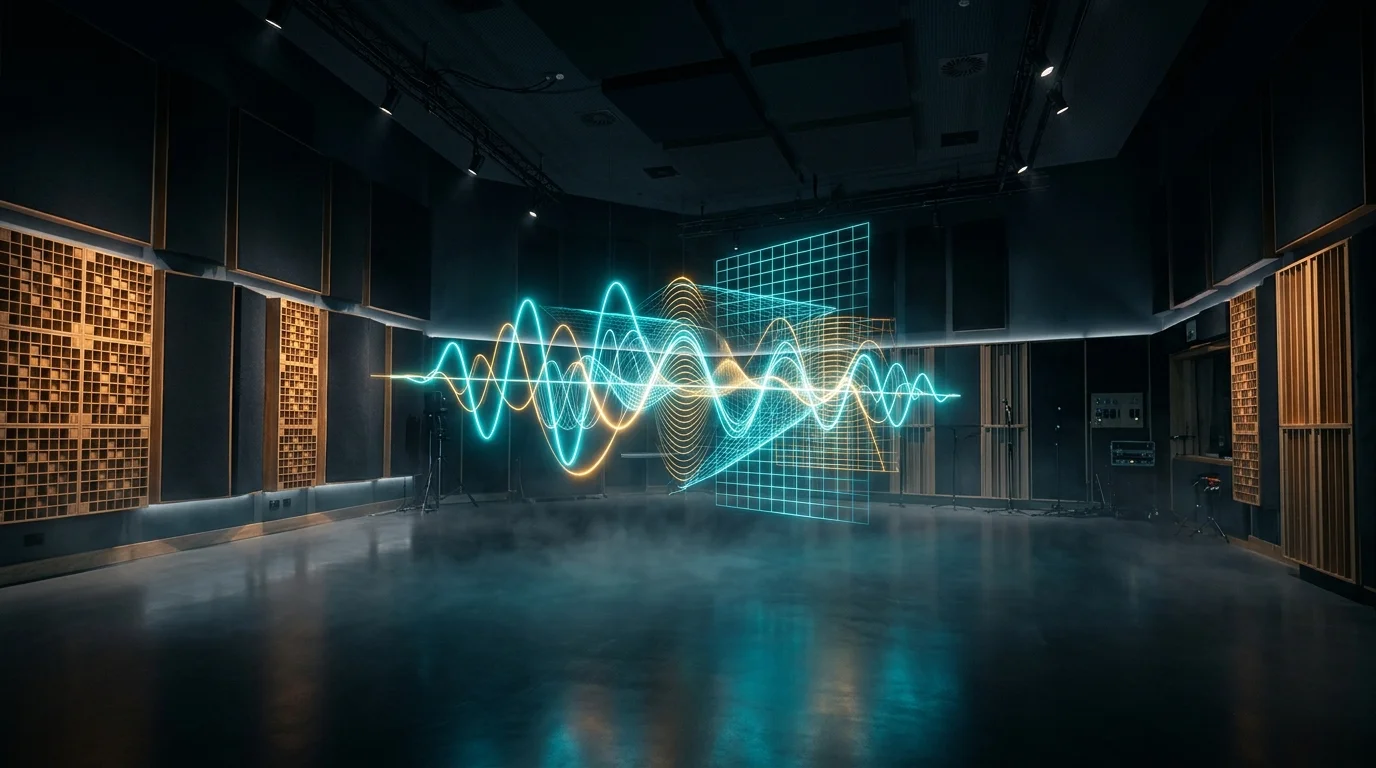
Anatomy of a Sound Wave: Frequency, Wavelength, Period, and Speed of Sound
Sound propagates through air as a longitudinal mechanical wave; air molecules oscillate back and forth parallel to the direction of wave travel. This alternating movement generates cyclical physical states: regions of compression (where air density and pressure exceed equilibrium) and regions of rarefaction (where air density and pressure drop). The human eardrum and microphone diaphragms translate these microscopic pressure variations into neural impulses and audio voltage.
Frequency (f) measured in Hertz (Hz) defines the number of completed compression-rarefaction cycles per second. It shares an inverse relationship with time Period (T): T = 1 / f. For instance, a 100 Hz wave completes its cycle in 10 milliseconds, whereas a deep 20 Hz sub-bass wave demands a full 50 milliseconds to complete one cycle.
The speed of sound in dry air at 20°C (68°F) at sea level is approximately 343 meters per second (1,125 ft/s or 1,235 km/h). Speed increases with temperature following the relationship c ≈ 331.3 + (0.606 × θ), where θ is temperature in Celsius.
Wavelength (λ) is the physical distance traversed during one complete cycle, determined by the fundamental equation λ = c / f. The physical dimensions of low frequencies are enormous: 20 Hz spans 17.15 meters (56.3 ft), 50 Hz spans 6.86 meters (22.5 ft), and 100 Hz spans 3.43 meters (11.25 ft). In sharp contrast, a 10 kHz treble wave spans a mere 3.43 centimeters (1.35 inches).
This massive physical disparity explains why typical bedroom studios struggle with bass: in a 4-meter room, a 50 Hz wave cannot complete a single physical cycle before slamming into opposing boundaries, triggering intense reflections and standing wave interference.
Sub-bass frequencies below 80 Hz have physical wavelengths between 4.3 and 17 meters. In small domestic rooms, bass does not propagate as free-field waves; the room behaves as a sealed pressure chamber where acoustic boundaries exert heavy reactive resonance.
Phase Relationships, Wave Interference, and the Destructive Comb Filter
Phase describes the instantaneous position of a waveform within its 360-degree (2π radian) cycle at any given point in time. When multiple sound waves of identical or related frequencies coincide in a room or within a DAW mixer, their pressure vectors combine according to the Principle of Superposition.
Constructive Interference: When two waves arrive in perfect phase alignment (0° phase offset), compressions align with compressions and rarefactions with rarefactions. The combined amplitude doubles, yielding an exact +6 dB gain boost. Instruments sound focused, punchy, and impactful.
Destructive Interference (Phase Cancellation): When two identical waves meet with a 180° phase offset (a half-wavelength difference, λ/2), positive pressure cancels negative pressure, resulting in complete mathematical silence (-Infinity dB). In mixing, phase cancellation manifests as disappearing sub-bass, hollow snare drums, or weak vocals collapsing when summed to mono.
Comb Filtering: Occurs when a direct sound combines with a short-delayed replica of itself (typically 1 to 15 milliseconds later). At frequencies where the delay corresponds to an integer multiple of the wavelength, constructive summing occurs (+6 dB); at frequencies where the delay equals a half-wavelength, destructive notches plunge down to -20 dB. The resulting frequency response resembles the teeth of a comb.
Common culprits of comb filtering in home studios include: acoustic reflections off the hard desk surface, computer monitors situated between studio monitors, unpadded sidewalls, and multi-mic setups lacking strict 3:1 distance adherence.
To test if your work surface is causing comb filtering, play continuous white or pink noise through your monitors while placing a thick folded blanket across your desktop. If the harshness immediately softens and midrange clarity improves, your desk reflection is coloring your sound.
Constructive Interference
Perfect Wave CoherencePositive peaks sum coherently, delivering a solid +6 dB boost. Low-end retains tight transient punch and authoritative acoustic energy.
Destructive Cancellation
Phase Inversion AnnihilationCompressions clash directly with rarefactions, canceling audible energy. Results in hollow, phasey audio that disappears in mono playback.
Acoustic Comb Filtering
Desk & Boundary ReflectionsDeep cyclic notches carve through mid and treble frequencies, skewing listening perception and forcing engineers to make flawed EQ moves.
Phase Correlation Meter
Stereo Coherence MonitorMonitors stereo coherence on a scale from +1 (pure mono) to -1 (completely out of phase). Professional tracks maintain healthy +0.5 to +1 ranges.
Room Modes, Standing Waves, and the Critical Schroeder Frequency
When sound waves reflect back and forth between parallel studio boundaries, specific frequencies match room dimensions and become trapped. This phenomenon creates standing waves (Room Modes or Eigenmodes). Unlike traveling waves, standing waves have fixed spatial nodes (points of zero acoustic pressure) and antinodes (points of maximum pressure). Walking across an untreated room reveals deafening bass booms in certain spots and total bass absence just one step away.
Acoustic modes fall into three geometric classifications:
1. Axial Modes: Waves traveling along a single dimension between two parallel surfaces (length, width, or height). They carry the highest energy and cause over 90% of severe monitoring distortions in small rooms.
2. Tangential Modes: Waves reflecting off four surfaces across two dimensions. They carry half the acoustic energy of axial modes.
3. Oblique Modes: Waves engaging all six room boundaries simultaneously, carrying one-quarter the energy of axial modes.
Axial modal frequencies are computed via the formula f = c / (2L), where L represents room length. For a room 4 meters long, the fundamental axial mode is f = 343 / (2 × 4) = 42.8 Hz. Harmonics at 85.7 Hz, 128.6 Hz, and 171.5 Hz also ring out with prolonged decay times.
The Schroeder Frequency (fs): The critical boundary dividing a room’s acoustic behavior. Below fs (the modal zone, typically 100 to 250 Hz in domestic rooms), sound behaves strictly according to discrete standing wave resonances. Above fs (the ray optics zone), sound acts like light rays obeying specular reflection angles.
Why software EQ calibration cannot fix phase nulls: Many novice producers attempt to fill -15 dB modal bass dips using room-correction EQ (e.g. Sonarworks). In a physical cancellation null (180° out of phase), boosting the speaker sends more energy into the room, which simply reflects back with equal and opposite cancellation. The null remains, while the woofer amplifier distorts and burns valuable headroom.
Destructive phase nulls are physical geometry problems, not loudspeaker flaws. Curing nulls requires physical repositioning of speakers and listening chairs (following the 38% rule) paired with heavy porous and membrane bass traps in room corners.
Sound at Physical Boundaries: Porous Absorption, Bass Traps, and Diffusion
When a sound wave impacts a physical boundary, the law of conservation of energy governs the outcome: E_incident = E_reflected + E_absorbed + E_transmitted.
Porous Absorbers: Materials such as dense mineral wool (Rockwool at 50 to 80 kg/m³ density) or fiberglass attenuate sound energy by forcing oscillating air molecules through microscopic fibrous matrices, transforming kinetic energy into heat via viscous friction. The quarter-wavelength rule (d ≥ λ / 4) applies: air velocity reaches its maximum at one-quarter wavelength from a rigid wall. To absorb a frequency efficiently, porous treatment must be at least λ/4 thick or spaced at that distance. Thin 2-inch studio foams absorb only high frequencies above 3 kHz, leaving dangerous low-end modes entirely untouched.
Resonant Membrane Bass Traps: Absorbing deep sub-bass below 80 Hz with porous absorbers requires impractical depths exceeding 30 to 40 cm. Sealed membrane or limp-mass traps operate on acoustic pressure rather than particle velocity. A tuned limp membrane vibrates in sympathy with target frequencies, dissipating energy efficiently within compact enclosures positioned in high-pressure corners.
Reflection-Free Zone (RFZ): Early reflections reaching the ears within 20 milliseconds of direct monitor sound blur stereo localization and transient perception. Applying the Mirror Trick—placing a mirror flat against side walls and ceiling until the speaker drivers are visible from the listening position—pinpoints the exact first-reflection spots needing 10-15 cm broadband absorption panels.
Acoustic Diffusion: An optimal control room is never anechoic (completely dead). Over-absorbing rooms causes ear fatigue and leads to dull, lifeless mixes. Quadratic Residue Diffusers (QRD) scatter specular reflections across space and time with randomized phase coherence, preserving natural room vitality while eliminating flutter echoes.
| Acoustic Treatment | Effective Frequency Band | Physics Mechanism | Studio Application & Result |
|---|---|---|---|
| Thin Foam Wedges (1-2 inch) | 3 kHz - 20 kHz (Treble only) | Surface air friction | Ineffective on bass; creates unbalanced, muffled, and boomy rooms |
| Broadband Mineral Wool (4-6 inch) | 150 Hz - 20 kHz | Kinetic-to-thermal dissipation (λ/4) | Treats early reflection points on side walls and ceiling clouds |
| Corner Superchunk Bass Traps | 60 Hz - 300 Hz | High-density corner friction | Tames low-end modal ringing and smooths kick and sub-bass response |
| Tuned Membrane Bass Traps | 30 Hz - 80 Hz (Deep Sub) | Sympathetic mechanical mass resonance | Tackles primary axial room modes without sacrificing studio floor space |
| Mathematical QRD Diffusers | 500 Hz - 5 kHz | Phase-shifting depth wells | Maintains room energy, delivers wide stereo imaging, stops flutter echo |
Psychoacoustics and Human Perception: Fletcher-Munson Curves and RT60
The human auditory system is not a linear measurement instrument. In 1933, Harvey Fletcher and Wilden Munson mapped equal-loudness contours (modernized as ISO 226), demonstrating that perceived frequency balance shifts drastically depending on listening sound pressure level (SPL).
Human ear canal resonance naturally magnifies sensitivity in the 2 kHz to 5 kHz band—the evolutionary range of human speech intelligibility and infant distress cries. Conversely, human hearing sensitivity drops sharply below 100 Hz at moderate and quiet playback volumes.
The Monitoring Volume Danger: Mixing at low levels (under 60 dB SPL) causes the brain to perceive low and high frequencies as quiet, tricking producers into boosting excessive sub-bass and top-end sheen. Played back in a club or car system, such mixes distort immediately. Conversely, monitoring above 85 dB SPL induces ear fatigue and triggers the stapedius reflex, which dampens acoustic dynamics.
The Golden SPL Sweet Spot: For small-to-medium home and project studios, the calibrated monitoring target is 76 to 82 dB SPL (C-Weighted, Slow response at the listening position). At this volume, the human ear operates closest to an equitable tonal balance across sub, mid, and air frequencies.
Reverberation Time (RT60): Defines the duration required for acoustic reflections to decay by 60 dB following sound cessation. In critical mixing and production control rooms, target RT60 ranges between 0.20 and 0.35 seconds uniformly across the entire audible spectrum.
Using a calibrated sound level meter (or accurate smartphone decibel app set to C-Weighting and Slow), play -20 dBFS RMS pink noise through your monitors and adjust your audio interface output until it reads 78 to 80 dB SPL. Mark this knob position with tape as your trusted mixing reference point.
Harmonic Voicing & Room Acoustics in MojoMelody: The Low-Interval Limit
A frequently overlooked boundary in music production is the intimate relationship between harmonic voicing and low-end room physics. Music theory and acoustic science converge on the Low-Interval Limit (LIL): the lower a chord descends in frequency, the wider its harmonic intervals must be voiced.
When close intervals—such as minor or major thirds—are played simultaneously below C3 (130 Hz), their wavelengths are close enough to generate aggressive beat frequencies and severe acoustic roughness. In untreated or small rooms, these intermodulation frequencies immediately stimulate room modes, creating an impenetrable wall of low-frequency mud.
How MojoMelody Solves Low-End Acoustic Clutter: MojoMelody’s intelligent chord and voicing engine embeds core acoustic physics directly into its generative algorithms:
1. Low-Interval Limit Enforcement: Bass roots and fifths are voiced cleanly across lower octaves, ensuring minimal phase interference with kick drums and modal room modes.
2. High-Register Harmonic Extensions: Complex chord colors (3rds, 7ths, 9ths, and 11ths) are systematically voiced above C3, in the frequency region where domestic room acoustics and acoustic absorption panels deliver pristine definition.
3. Transient and Velocity Balance: MojoMelody exports MIDI progressions engineered with realistic human velocity, avoiding sustained resonant spikes that trigger room ringing and allowing arrangements to translate with clarity on any sound system.
No compressor, EQ plugin, or bass trap can rescue an arrangement that violates low-interval limits in the sub register. Aligning musical harmony with wave physics is the first and most critical step toward punchy, club-ready audio.
Frequently Asked Questions
Q:Why is bass noticeably louder in room corners than at my desk chair?
Room corners represent the intersection of two or three rigid boundaries where acoustic particle velocity drops to zero and pressure builds to its theoretical maximum (Pressure Antinodes). All axial, tangential, and oblique room modes terminate in corners, creating massive bass accumulation.
Q:Are cheap egg-crate acoustic foams effective for bass trapping?
No. Lightweight open-cell polyurethane foams (1 to 2 inches thick) only absorb high frequencies above 3 kHz due to lack of mass and depth. They leave multi-meter bass wavelengths untouched, resulting in an unnaturally muffled room with unresolved, boomy low-end.
Q:Why should I avoid placing my listening position in the exact center of the room?
The geometric center of a rectangular room (50% length and width) is a primary pressure node where opposing room reflections cancel out at fundamental modal frequencies. Sitting there places your ears in a massive bass null. Acoustic guidelines recommend sitting at roughly 38% of room length from the front wall.
Q:How can I differentiate between a bad mix decision and room acoustic distortion?
Cross-reference your mix on high-grade open-back monitoring headphones. If the kick and sub-bass sound tight, balanced, and punchy on headphones but boomy or thin on your studio monitors, the defect is caused by room modes and comb filtering, not your mixing plugins.