Sonic Psychology of Suspense: Why the Human Ear Craves Tonal Ambiguity
In contemporary scoring and record production—from the legendary cinematic landscapes of Hans Zimmer, Jóhann Jóhannsson, and Hildur Guðnadóttir to the haunting intros of modern pop, drill, and dark ambient—nothing captures a listener's imagination faster than harmonic suspense.
Novice producers frequently assume that conveying gloom or darkness requires simple minor triads (like Am or Em). However, modern listeners have been conditioned through decades of media to recognize standard diatonic cadences instantly. When a chord deliberately withholds its emotional third—neither resolving into cheerful major nor somber minor—the human brain enters an intense state of auditory wonder and heightened curiosity.
Anatomy of Suspended Chords (Sus2 & Sus4): Escaping Diatonic Clichés
The core pillar of ambient and soundtrack harmony is the complete removal of the third degree. In traditional harmony, the third dictates emotional certainty. By substituting the third with either a major second (Sus2) or a perfect fourth (Sus4), suspended chords liberate arrangements from static emotional polarity.
Csus2 (voiced C-D-G) radiates an airy, glacial, cosmic stillness—as though floating above an infinite ocean or orbiting an alien planet. Conversely, Csus4 (voiced C-F-G) introduces a majestic, ancient dramatic pull, generating an irresistible longing for resolution that sets the perfect stage before drums arrive.
Never cluster suspended chord tones tightly in the lower registers. Physical acoustics demand that you anchor the fundamental in the sub register (C1), place the open fifth in the low-mid (G2), and elevate suspensions (D3, F3, G3) into higher octaves so overtones can breathe with pristine definition.
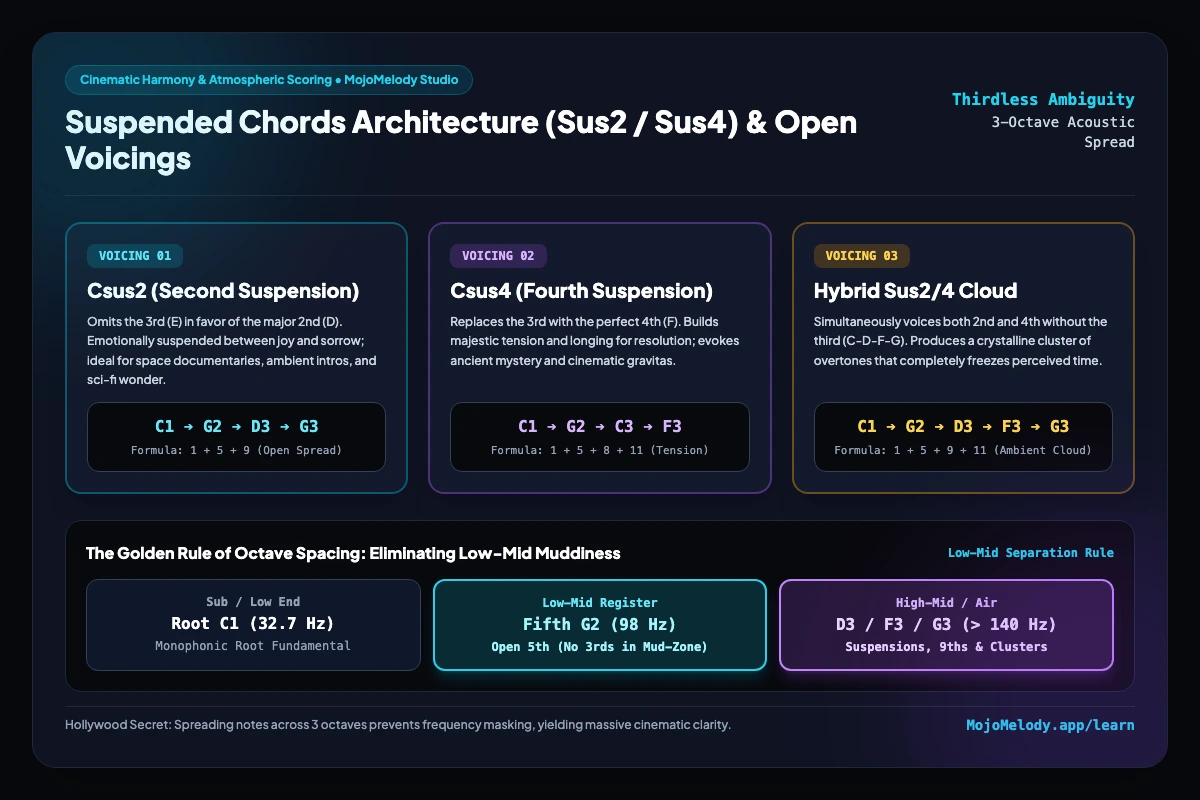
Formulas for open suspended voicings, isolating sub-bass, low-mid, and air registers to prevent acoustic frequency muddiness in film arrangements.
Pedal Point Architecture: The Immovable Anchor of Cinematic Dread
The pedal point is simultaneously one of music history's oldest and most formidable sonic techniques. It involves maintaining an unwavering, continuous bass note (usually the root or dominant) across multiple measures while upper chordal structures constantly shift above it.
Imagine sustaining a powerful low C1 bass. While this immovable pedal rumbles beneath, you cycle through C major, D major (D/C), F minor (Fm/C), and A♭maj7 (A♭maj7/C) in the upper register. The acoustic friction between the moving upper harmonies and the static anchor yields immense cinematic weight without needing a single drum transient.
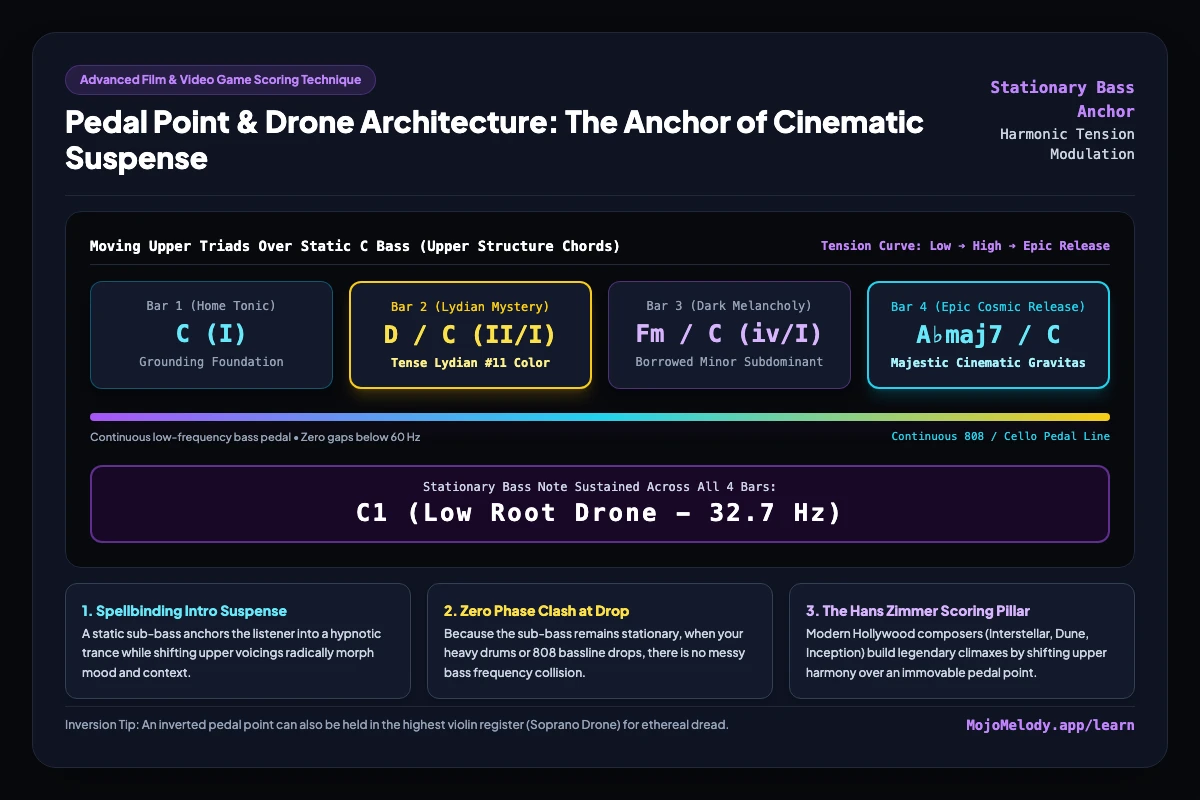
Harmonic tension curve progressing from home tonic into Lydian wonder, borrowed minor melancholy, and majestic cosmic release over a continuous drone.
Mysterious Intervals: Lydian (#4), Augmented Triads & Polychords
To transport harmony beyond conventional borders, composers employ modal interchange and advanced harmonic coloration. The most awe-inspiring interval in cinematic storytelling is the augmented fourth (#11) inherent to the Lydian mode. In the key of C, introducing F# instantly evokes cosmic discovery, divine intervention, and celestial magic.
Equally potent are polychords—the simultaneous voicing of two distinct triads in separate registers (e.g., D major in the right hand over C major in the left). Combined with symmetric whole-tone augmented triads (Caug), polychords suspend conventional tonal gravity, producing surreal, weightless tension ideal for psychological thrillers and sci-fi epics.
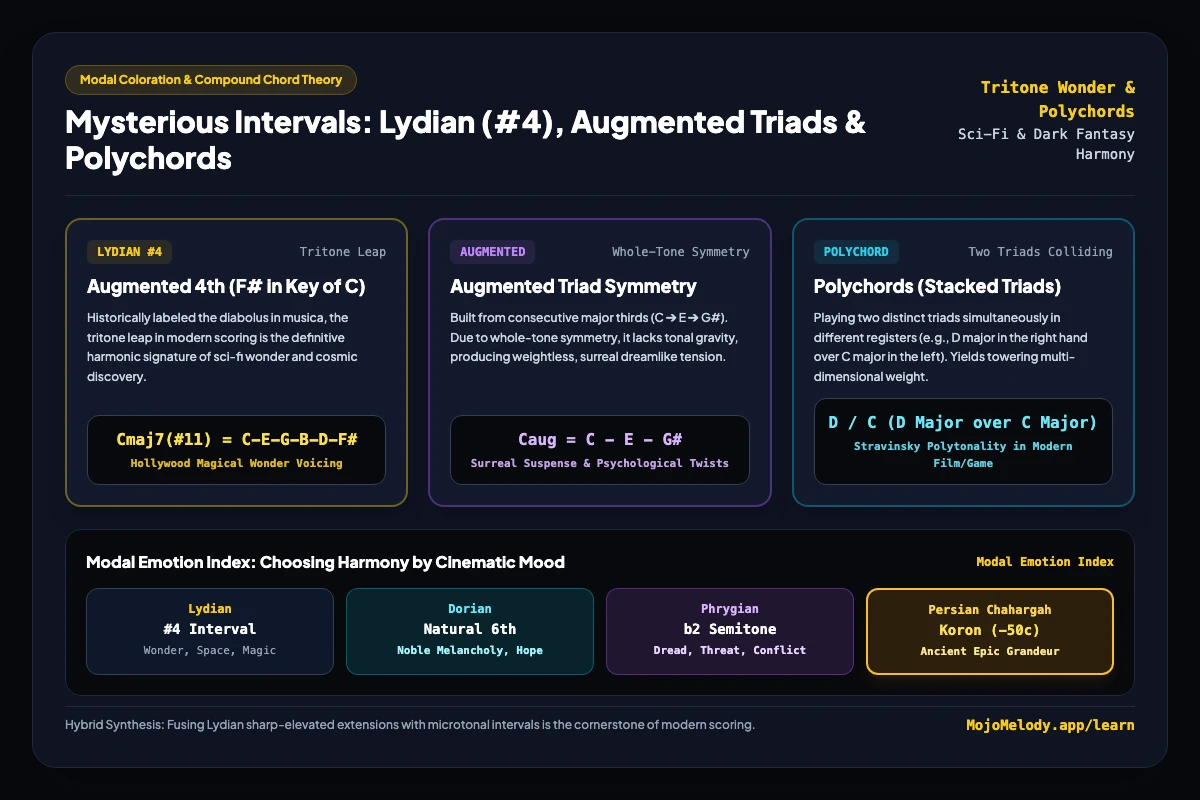
Dissecting the tritone leap of Lydian wonder, whole-tone symmetry of augmented triads, and multi-dimensional harmonic collisions in polychords.
Production Workflow: Designing Ethereal Textures in MojoMelody
Manually voicing complex, multi-octave cinematic chords in DAW piano rolls often leads to frustrating phase cancellation, frequency masking, or dissonant voice clashes. MojoMelody eliminates the guesswork by providing dedicated Cinematic, Ambient, and Lydian harmonic presets.
The theoretical engine automatically distributes wide open voicings across 3 octaves, incorporating humanized velocity waves and subtle pitch drifts. Simply audition voicings in real-time, then drag-and-drop the pre-voiced MIDI directly onto your Kontakt, Omnisphere, Serum, or orchestral piano tracks.

Instant selection of modal and ambient chord engines, real-time audition of 3-octave open voicings, and direct MIDI drag-and-drop into DAW tracks.
Reference Matrix: 6 Iconic Cinematic Progressions and Their Emotional Roles
The following reference matrix categorizes six battle-tested cinematic chord progressions, detailing their interval formulas, psychological profiles, and practical film/game scoring applications:
| Harmonic Formula Name | Chord Sequence (Key of C) | Emotional & Dramatic Profile | Cinematic & Genre Application |
|---|---|---|---|
| Cosmic Sus Suspension | Csus2 ➔ Gsus4 ➔ Am7 ➔ Fsus2 | Weightlessness, celestial majesty, gentle hope | Modern pop intros, space documentaries, ambient electronica |
| Lydian Wonder | C ➔ D/C ➔ Cmaj7(#11) ➔ G/C | Magic, cosmic revelation, awe-inspiring discovery | Fantasy video games, sci-fi scoring, adventure trailers |
| The Zimmer Pedal | C ➔ Fm/C ➔ A♭/C ➔ Csus4 | Massive gravity, immense suspense, impending doom | High-stakes thrillers, sci-fi epics, intense action buildups |
| Psychological Mystery | Cm ➔ Caug ➔ Cm6 ➔ Cdim7 | Nightmarish disorientation, paranoia, surreal twists | Psychological thrillers, detective mysteries, horror suspense |
| Ancient Eastern Epic | C ➔ Dp(sus) ➔ Fm ➔ C5 | Ancient martial dignity, warrior soul, mythic depth | Hybrid trap intros, historical films, martial game scores |
| Timeless Ambient Cloud | Csus2/4 ➔ E♭maj9 ➔ B♭sus2 ➔ C | Total immersion, frozen time, meditative serenity | Meditation tracks, ambient soundscapes, reflective song outros |
Frequently Asked Questions
Q:Why are Sus2 and Sus4 chords more effective than standard major/minor in song intros?
Because they omit the emotional third, refusing to declare whether the musical landscape is happy or sad. This tonal ambiguity keeps listeners in suspense, sparking profound curiosity before the rhythm kicks in.
Q:How does the pedal point prevent low-end phase clashing during a beat drop?
A pedal point anchors sub-bass energy on a single stationary frequency (e.g., C1). Because there is no erratic pitch hopping in the low register, when the main drums and 808 drop, the transition hits with maximum punch and zero phase smearing.
Q:What is the Lydian #4 interval and why does Hollywood associate it with wonder?
The augmented fourth (such as F# in C major) forms a tritone above the root that exerts an upward pull toward the dominant and octave. Pioneered by masters like John Williams (E.T.) and modern film composers, it conveys flight, magic, and cosmic beauty.
Q:How do you prevent lush cinematic synth pads from sounding muddy?
Avoid clustering notes in the 100 Hz to 300 Hz mud zone. Place the root in the sub register (C1), the fifth in the low-mid (G2), and push all suspensions, 9ths, and color tones above C3 to maintain pristine acoustic definition.
Q:How does MojoMelody accelerate cinematic harmony production?
MojoMelody provides pre-engineered 3-octave open voicings, modal interchange algorithms, and pedal point progressions out of the box, allowing composers to audition and drag-and-drop production-ready MIDI straight into their DAW in seconds.